Ubben Posse Fellow Interviews: Cecilia Rouse
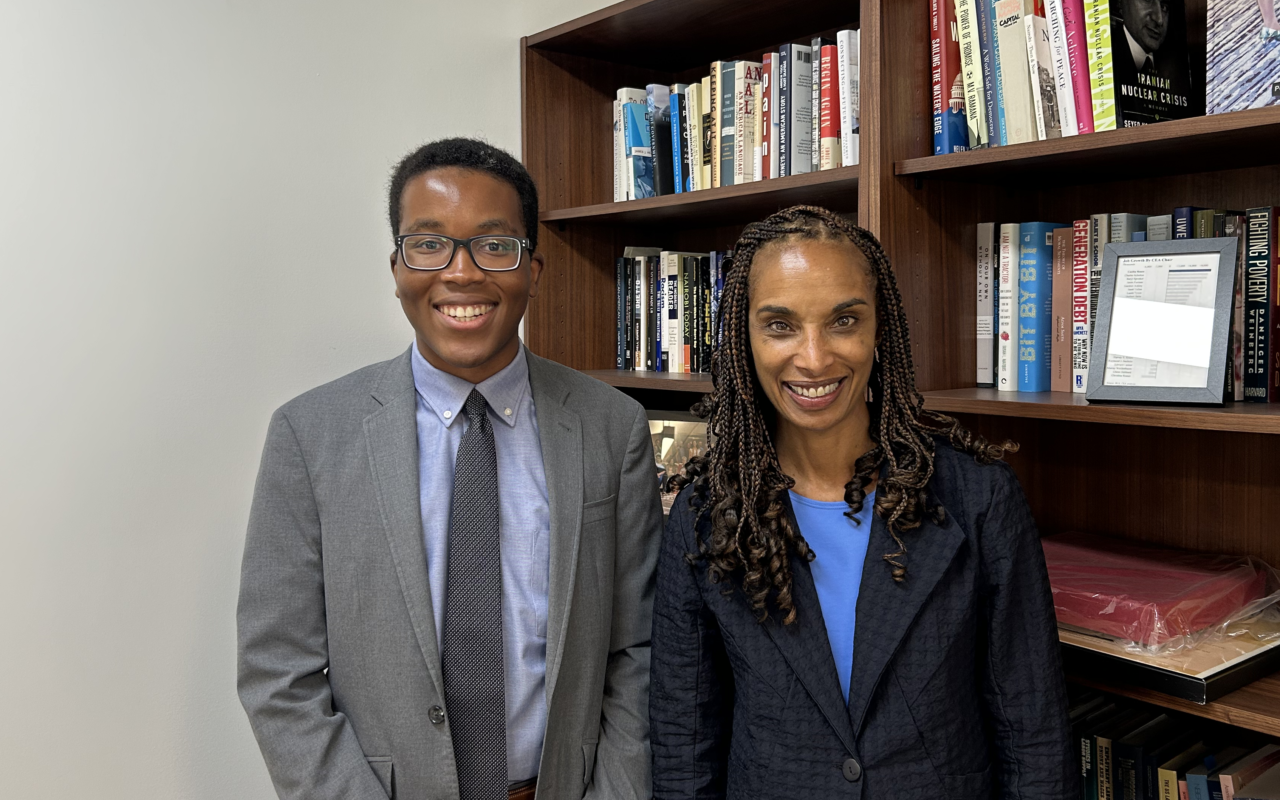
The Jeff Ubben Posse Fellows Program awards five exceptional Posse Scholars $10,000 each and the chance to spend 4-6 weeks during the summer shadowing and learning from a major industry leader. The interview below with Cecilia Rouse, Brookings Institution President, was conducted by Posse Scholar Bryson Handy, now in his junior year at The George Washington University, who worked with Cecilia Rouse as a 2025 Jeff Ubben Posse Fellow. The conversation has been edited and condensed.
BRYSON: I’d love to start from the beginning. Can you tell me about your childhood?
Cecilia Rouse: I was raised in Del Mar, which is in Southern California, with a brief but impressionable stint in Washington, D.C. when I was very young. Del Mar was a small beach town when my parents moved in. The weather was nice but it wasn’t a very racially diverse community. I was one of only a handful of Black students out of a high school of four hundred. The other thing I’d say is that education was very important to both of my parents. My dad was the first African American PhD physicist from Caltech and my mom earned a couple of master’s degrees. All three of their children went on to earn PhDs.
While a professor at Princeton, you also served on the National Economic Council and Council of Economic Advisors. How did your research background shape your policymaking in those roles?
The role of the National Economic Council (NEC) is to coordinate policy around the administration. For example, I worked on H1B visas in the Clinton Administration, and we grappled with the question of whether to raise the cap on the number of these non-immigrant visas. The NEC’s role was to develop a position and policy strategy for the administration, which can be tricky when different agencies see the problem differently.
Data was critical to helping us weigh different options especially in an area such as immigration. That said, for many questions the data were rather incomplete, so at times we had to use anecdotal evidence as it was the best we had.
Under President Obama, I was one of the three members of the Council of Economic Advisers (CEA). The CEA is like a think tank within the administration. The role of the CEA is to provide the president with objective insights and advice on economic data and policy. To do so one starts to appreciate the value of having a diversity of viewpoints around the table. As scientific or as objective as anyone might think of any subject, including economics, the questions one chooses to ask are informed by one’s experience and worldview. When everybody has the same life history and experiences, only a limited number of questions will be asked.
We live in a time of political polarization and crisis. Throughout your whole career, you’ve emphasized evidence to guide your leadership and policymaking. During my fellowship, I’ve noticed the importance you place on ensuring that we get even minor details right. And I know you have a saying, “It takes an idea to beat an idea.” So, what do you think is the role that think tanks like Brookings will play in shaping the future of public policy, and how are you using your leadership to guide the policy space towards a more evidence-based direction?
How the federal government and the world have been operating has been far from perfect. That’s always going to be true, because there’s no perfection in life. But we have some really wicked problems, like increasing income inequality, a healthcare system designed around having a job forever, the high costs of childcare, and planning for economic growth in an age of declining fertility rates. We also have many systems that were designed for a different time such that we’ll have to be creative and bold in how we address these issues. So, I think that evidence-based decision-making is always challenging oneself, asking hard questions, and seeing plausible arguments from the other side.
That is exactly what Brookings is working on. To disagree with how others tried to address some of those wicked problems is one thing, but then you’ve got to propose actionable solutions along with the evidence that explains why your solution may be better. The scholars at Brookings are seeking to better understand some of the most pressing and complicated issues of today and to develop smart, creative, and informed ways of addressing them. Challenges such as the federal government debt, revitalizing U.S. democracy, developing an effective education curriculum for today’s world, improving health care outcomes while also reducing costs, and how the U.S. competes with China are among the many ambitious projects our scholars are undertaking. While our ideas may not result in concrete policy change immediately, it is important to have creative, credible and actionable ideas ready for when they may be politically possible. Afterall, it takes an idea to beat an idea.