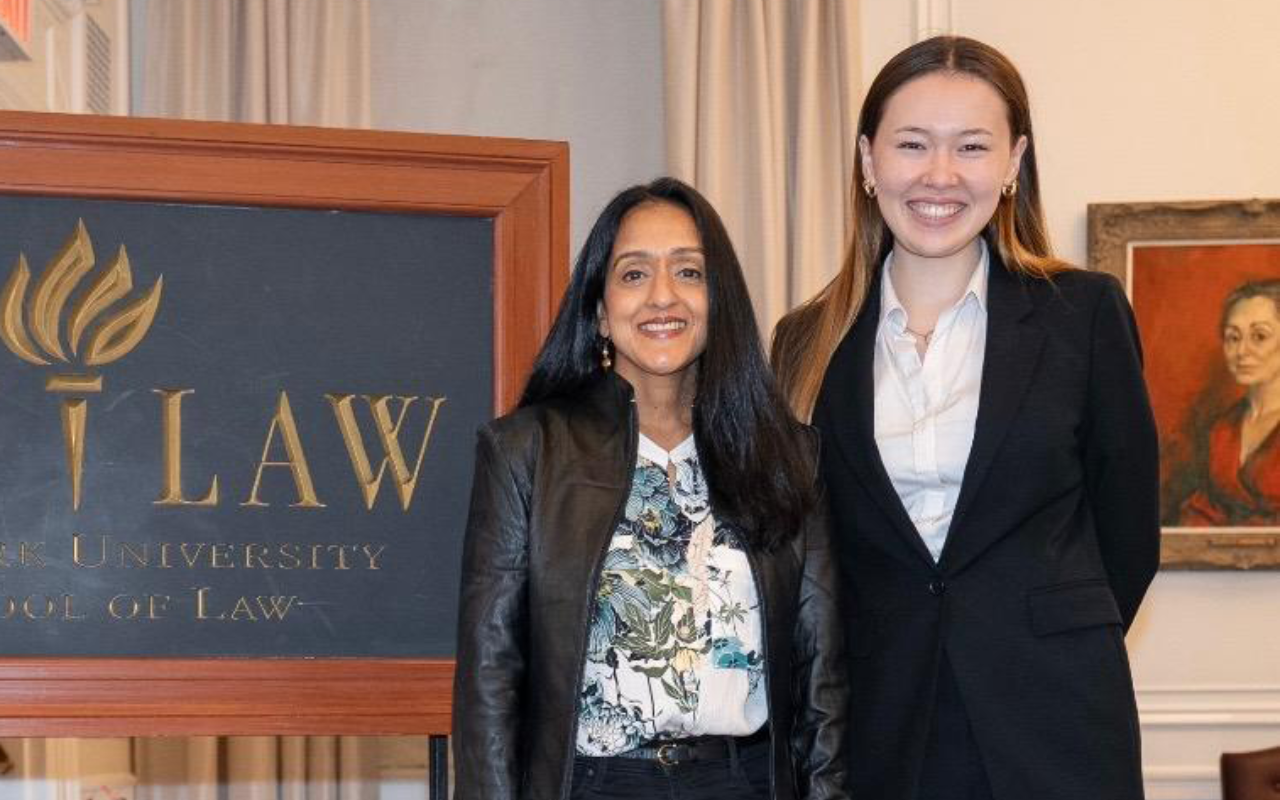
Ubben Posse Fellow Interviews: Vanita Gupta
The Jeff Ubben Posse Fellows Program awards five exceptional Posse Scholars $10,000 each and the chance to spend 4-6 weeks during the summer shadowing and learning from a major industry leader. The interview below with Vanita Gupta, Executive Director of the Center for Law and Public Trust at New York University School of Law, was conducted by Posse Scholar Anna Van Riesen, a current junior at Lehigh University, who worked with Vanita Gupta as a 2026 Jeff Ubben Posse Fellow. The conversation has been edited and condensed.
ANNA: Tell me about your parents. How did they, and your broader context growing up, influence your leadership?
VANITA GUPTA: My parents immigrated from India in the late ’60s, so I was born in Philadelphia. I’m a birthright citizen, just to make that point! When I was four years old, we were transferred to England for five years. Then we were transferred to France for five years, moved back to England for high school, and I came to the US for college. My parents had a huge impact on my outlook as a leader. My father would sometimes quiz my sister and me about things happening in the news, because he wanted us to be engaged with the world and to ask a lot of questions. We both had a lot of opinions about what was happening in Europe and in the United States, so in college I became a bit of an activist. That early push to read and think about the world we lived in was part of my leadership development—I started seeing myself as part of a community, and caring about that community.
During your undergraduate studies at Yale, what particular leadership experiences shifted how you think about leadership?
I did a lot of organizing on campus. California had passed a ballot initiative that would ban immigrant children who didn’t have documentation from attending K-12 schools, and there was concern that the policy would spread around the country. A lot of people were concerned, so we tried to find ways for them to see themselves as agents of change rather than bystanders. In these moments when people are outraged or really upset, we shouldn’t just admire the problem; someone needs to actually be the first person to say, “Let’s get together and talk about this.” As an organizer, leadership was about persuading people to care and identifying concrete ways they could engage. That was leadership—seeing a need, bringing people together for a conversation, and creating avenues for engagement to make a difference. That lesson from college has continued with me today.
What shaped your interest in public interest law?
I had spent two years after college working at a school of public health, looking at the problem of youth violence. This was at a time in the 90s when there was this “super predator” narrative that was leading to the incarceration of younger and younger children. I remember going to some of the family courts, seeing exclusively black and brown kids, and thinking “Why do some kids get non-punitive, non-carceral public health interventions to help them get on the right path, while other kids are criminalized and pushed deeper into the system?” I saw the promise of the public health approach, but the public policy around incarceration was becoming increasingly punitive. So, I went to law school wanting to work on the problem of criminal justice, and I loved it. The deeper I got, the more committed I became to criminal justice issues and the problem of mass incarceration in this country.
There are a lot of miserable lawyers out there, and I am not among them. In part, that’s because even on the worst days when I feel like I’m spinning my wheels, I feel like I’m living a meaningful life and trying to make a difference in people’s lives. It’s hard work, because it’s often against the grain, but it’s good work. Public interest work has been incredibly gratifying for me because I don’t have to ask the ‘why’ of what I’m doing. The ability to answer that question even on the hard days is uniquely available for people who go into public interest or public service.
That’s reassuring to hear! How would you say the people around you who work with you would describe your leadership style?
I think people would say that I am a vulnerable leader. I don’t pretend to have all the answers because I don’t believe that a leader needs to. The best leaders build strong teams and deploy their team’s expertise to delegate and get answers. I seek out people around me who are going to challenge my decision-making and provide all the data, so that before I make a decision, I understand what all the equities are. Some leaders lead with fear and want to be feared, but I just don’t think you see people deliver at their best in that environment.
I also try to explain to people why we’re doing what we’re doing, so that everyone from an assistant to a senior legal counsel can see themselves as part of a broader endeavor. People at every level of an organization need to feel mission investment. There is expertise that resides with younger folks like our interns that the more senior folks at the center don’t have, and I want to learn from that expertise; I see expertise everywhere, and I think it’s important for leaders to do that.
What would you say is one of the hardest decisions you’ve had to make as a leader?
The hardest thing in leadership is dealing with problems internally. Sometimes you have to say hard truths to have a functioning team, especially in public service, and I’ve had to learn to deal with conflict in internal team dynamics. It sounds mundane, and it’s less glorious than something like deciding whether to prosecute a case, but without a leader willing to resolve conflict and have these hard conversations, all the work will fall.
One other tangible thing is having to make a decision that is going to be perceived as very unpopular, but if you know it’s the right decision, you just have to be willing to take all the heat for the team. It can be really, really hard when the easier path is the one that you think is the wrong path. Standing by your convictions and being willing to back them up in the face of public criticism is a hard part of leading.
What do you hope the next generation of leadership in law and at the DOJ prioritizes?
My hope is that they will prioritize justice and the rule of law. The Justice Department has a very large mandate; it’s the only cabinet agency named after a value, so seeking justice should be the north star for anyone at the department. Restoring the rule of law is going to be really challenging, because people see the department acting through a partisan lens. How do you build trust back in an institution that has such an impact on people’s lives in such a polarized environment? Most people understand government through how it operates locally, but there’s a very important role that the federal government plays in people’s lives. My hope is that the department will do better to communicate with the American people what it does, and why it’s doing what it’s doing, than it has in the past.
My last question is on behalf of any Posse scholars and future leaders that will read this interview. What do you want them to walk away knowing about leadership?
You’re not born a leader, you become a leader—and you don’t deserve leadership, you earn leadership. You have to model the behavior you’re hoping to engender. You have to give people a reason to want to be part of your team and to be led by you. That requires inspiration, ethical behavior, believing that everyone has something to contribute, and figuring out how to bring out the best in everyone. But it also requires accountability: when things go wrong, leaders need to hold themselves or team members accountable and do that fairly. Often, your leadership skills shine when you’ve been taken out of your comfort zone, you’re put in new contexts, and you have a chance to deal with discomfort—that’s important.
Here’s what I want you to know, and it’s especially important for women: you need to believe in your capacity for leadership. Even when I was Associate Attorney General, the third-ranking official in the US Department of Justice, I sometimes had imposter syndrome. I would think: “Why am I here? I fooled everyone. I’m a fraud” You have to do everything you can to tell yourself, “Actually, I belong in this room as much as anyone else. I may feel like I don’t know things, but other people don’t know some things either.” They may just play it off better! So you need to have this voice in your head when imposter syndrome comes in that says, “I belong in this room, I belong in this room, I belong in this room.” That is the only way that any of these rooms have come to accept new folks. You bring a whole wealth of experiences that are very unique and important to contribute—so when you’re in these rooms, remember that you belong there.