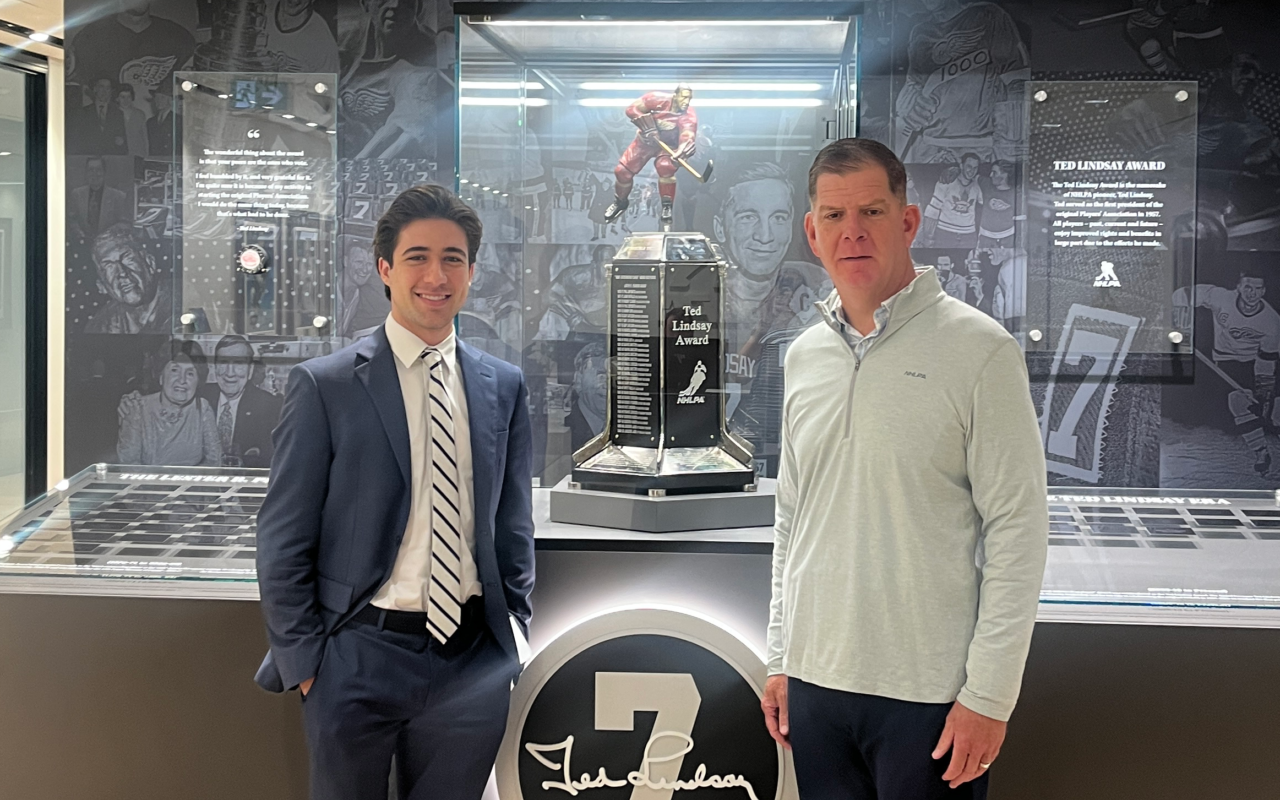
Ubben Posse Fellow Interviews: Marty Walsh
The Jeff Ubben Posse Fellows Program awards five exceptional Posse Scholars $10,000 each and the chance to spend 4-6 weeks during the summer shadowing and learning from a major industry leader. The interview below with Marty Walsh, Executive Director of the NHL Player’s Association, was conducted by Posse Scholar Adrian Stancil Martin, a current junior at Lawrence University, who worked with Marty Walsh as a 2026 Jeff Ubben Posse Fellow. The conversation has been edited and condensed.
ADRIAN: Before we talk about your career in public service and at the Players’ Association, I want to talk about your upbringing. When you think about your childhood in Boston, what experiences would you say have most shaped the person you would eventually become?
MARTY WALSH: Growing up in a family of Irish immigrants helped shape me. Growing up in a family that wasn’t rich helped shape me. Understanding Irish culture and traditions helped shape me. Growing up in a union household helped shape me as an advocate and fighter. Growing up going on picket lines and seeing my family advocate for workers who were out of work absolutely shaped me as a person, gave me my values, and gave me my passion for fighting for workers and the underdog. My core values are there because of the house I grew up in, and my ability to appreciate the other side came later. I don’t necessarily have to agree with the views people opposite of me have, but I don’t have to villainize them either. We all have our beliefs on certain issues, but politics and life are a compromise. When I was a kid, for example, if you were a businessman, you weren’t for the poor. Now I see a lot of businesses being supportive of nonprofits and foundations.
As a member of the Massachusetts State House, as Mayor, and as the Secretary of Labor, how did you balance staying true to your values while also allowing for compromise?
I do think the best opportunity is to try to get a seat at the table. I always tried to make sure that my office—whether it was as a state rep, mayor, Labor Secretary, or even in this job—had a seat at the table, because you can’t compromise, you can’t debate, and you can’t advocate if you’re not at the table.
And then as the mayor, you’re representing about 750,000 people. How did you balance staying true to your principles versus what different groups and people were asking of you?
I think you keep an open mind and listen to them. You try not to make it personal. If somebody disagrees with me, or I disagree with somebody, I try not to make it personal. And always listen, because there’s always something that the other side might be saying that could bring value to your thought process or your view of an issue. I think that’s something important.
Is there a specific moment that you can point to where this tension between your beliefs and others’ beliefs was especially difficult to navigate?
We did the Trust Act in the City of Boston. This was during Donald Trump’s first term, and it was about protecting immigrants. We had immigrant communities being unfairly targeted for political purposes. It was all a political game; I don’t think the administration truly believed that they were fighting immigration.
Early on, when you were first venturing into politics, you volunteered for state house campaigns, for members of the state senate, and for city council campaigns. At what point was politics something that you wanted to pursue through public service, not just through something like this?
I was a young kid— probably 11, 12, or 13 years old. I remember being at a rally with my uncle and my father, holding a sign for somebody. I don’t even remember what the sign said, but I remember thinking, “This is cool. I could do this.” From there, I just got involved. I became an activist, if you will. I got involved in my community, in Little League, in hockey, coaching— this and that. I just loved being involved and naturally gravitated toward it. Some people gravitate toward law, some toward business. For me, it was politics. I loved it. It was in my blood. I always knew I wanted to run for office someday. As I got older, into my teens and early twenties, I realized that I wanted to serve in the State House. I would have run for City Council if a seat had opened up, but the state representative seat opened up, and I’m very grateful that it did.
So it was just a matter of timing that the State House was where you headed?
It was about life and timing. It’s knowing in your heart if you’re ready for it or not. At the age of 25, I thought I was ready for it, but I really wasn’t, and I knew deep down I wasn’t ready for it. I got sober at the age of 28 or 29, in 1995. About six months after I got sober, I knew I was in a whole different headspace and spiritual space. Then, about a year and a half after I got sober, a seat opened up, and I knew I was ready for it. I was ready to run.
Over the course of your career, you’ve had to make decisions that have affected thousands, if not millions, of people. How has your approach to making these choices evolved over time?
It’s really about the issue. When I was a legislator and voting for marriage equality, I knew the impact. It was the first place in the country where marriage equality was legal. It was about supporting gay couples who wanted to get married and protecting their right to do so after the court gave them that right. As mayor during COVID, I had to shut down schools and businesses. You understand that, for the greater good, you have to do what’s right. There were a lot of different thought processes that went into those decisions; there’s not a single way of making them. Every issue is different, and every situation and circumstance is different.
Was there a specific decision where you truly felt the weight of public leadership, and how did it shape the way you made decisions from then on?
George Floyd got killed, and protests started to happen around the country. I knew that at that moment, in Boston and in the world, it wasn’t the time for another white person to give a speech on racial justice. I really leaned on people in my administration, people of color in my administration, to help me get through that moment. I felt the magnitude of what was happening in the country at that moment. I really leaned on people I worked with to come up with some solutions on how to move forward, and we instituted a lot of different things. This was an action moment and a listening moment, and I took a lot of time to listen.
Even today, at the Players’ Association, you continue to represent people, the players. What has surprised you the most about leading a labor union representing athletes compared to constituents as a state representative or mayor?
The perception is that professional athletes are millionaires. Not all hockey players are millionaires, and lots of hockey players are not going to become millionaires. They have struggles and challenges, just like people working in the field of construction or firefighters. You’re still dealing with people who have problems.
Knowing what you know now and having accomplished what you have accomplished, if you could sit down with your 20-year-old self, what would you tell him? What should he understand before entering public service?
Be true to your values. Try to become a good listener. Try not to be judgmental. And know that your 20-year-old positions on issues are going to change, and they’re going to evolve. You might have strong views on something today, and then, as you learn and talk to other people, you’ll understand it differently. If you told my 20-year-old self that I was going to vote against the death penalty, to raise taxes, and for gay marriage and transgender rights, I’d probably tell you that’s never going to happen. Some of those things weren’t really an issue at the time. But, you know, I did those things, and I’m proud of them. I’m proud of the work I did, particularly around marriage equality.